Can Water-Damaged Drywall Be Saved? When to Dry It Out and When to Replace It
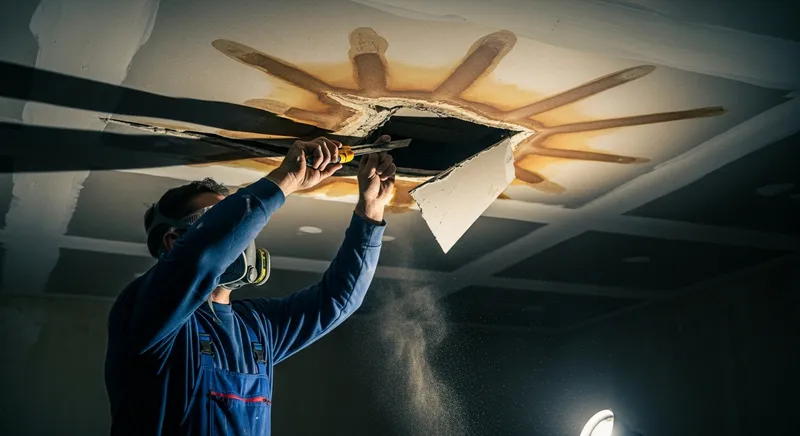
Quick Answer: Drywall that got briefly damp and dried within two days can usually be saved with drying, stain-blocking primer, and paint. Drywall that was soaked, stayed wet longer than 48 hours, swelled, sagged, or feels soft must be replaced — the gypsum core loses its strength permanently and becomes a breeding ground for mold. The cost of a water-damage repair depends mainly on how much board comes out, whether the insulation behind it got wet, and the texture that has to be matched.
How Do You Know If Wet Drywall Can Be Saved?
Press on it. If the board is still firm, shows only light surface staining, and the water source was brief — a splash, a quickly-caught supply line drip — it can usually be dried in place and refinished. If it feels soft, spongy, or crumbly, or if it visibly bulges or sags, the core is compromised and the board needs to come out. Paper facing that has bubbled or delaminated is another sign the board is done. When in doubt, a moisture meter reading tells the truth: drywall above roughly 17% moisture content after drying is not salvageable.
What Is the 48-Hour Rule for Wet Drywall?
Mold can begin colonizing wet building materials within a day or two. If drywall is dried below problem moisture levels inside that window — with fans, dehumidifiers, and airflow behind the wall if needed — mold usually doesn't get established. Past 48 hours of sustained wetness, assume mold is growing inside the wall cavity even if the surface looks clean. That's why fast action matters more than the amount of water: a small leak that drips for three weeks does far more damage than a bucket of water cleaned up right away.
What Are the Signs Water-Damaged Drywall Must Be Replaced?
- The board is soft, spongy, or crumbles when pressed
- Ceiling drywall is sagging or bellied between joists
- Brown or yellow stains keep growing or return after painting
- Paper facing is bubbling, wrinkling, or peeling away
- Any visible mold — spots of black, green, or gray fuzz
- A musty smell that persists after the area looks dry
Several of these overlap with the early indicators covered in our guide to the 7 warning signs of water damage behind your walls — if you're seeing them, the water has usually been there a while.
Why Can't You Just Paint Over Water Stains?
Because paint hides the symptom, not the problem. A water stain means moisture moved through the board; if the leak isn't fixed, the stain returns through fresh paint in weeks. And if the board absorbed enough water to weaken, paint does nothing for its structure. The correct sequence is: stop the leak, verify the material is dry and sound, then prime with a stain-blocking primer and repaint. If the board failed, it gets cut out and replaced first. Skipping steps is how homeowners end up painting the same ceiling three times.
What Affects Water-Damaged Drywall Replacement Cost in Utah?
From least to most involved, water-damage repairs usually fall into one of these:
- Dry in place, stain-block, and repaint — when the board stayed firm and dried quickly
- Small cutout — one damaged section cut back to framing and replaced
- Larger cutout with texture matching — more board, more finishing, more blending
- Ceiling water-stain repair — overhead work, often with the whole ceiling plane repainted
- Full wall replacement — common on basement walls after foundation seepage
The biggest cost variables are how much board comes out, whether insulation behind it was soaked, and the texture that has to be matched. Call (801) 791-9053 or use the contact form for a free written estimate. More on what drives repair pricing is in our drywall repair cost guide, and if the damage tips the math toward new board, our repair vs. replacement decision guide walks through the call.
Where Does Water Damage Hit Utah Homes Most?
Basements, first. Spring snowmelt and summer cloudbursts push water against foundations across the Wasatch Front, and finished basement walls in Layton, Bountiful, and Salt Lake City take the hit. Second are ceilings below bathrooms — supply lines, tub overflows, and failed wax rings. Third are exterior walls near roofline ice dams after heavy snow years. Because basements are the most common casualty, we handle water-damage rebuilds as part of our basement finishing service, replacing board, insulation, and texture in one pass — whether that's a basement in Kaysville or a basement in Taylorsville.
What's the Right Repair Process After a Leak?
- Stop the water. Fix the leak or grading problem first — no drywall repair survives an active leak.
- Dry everything. Fans and dehumidifiers until wood framing and remaining board hit safe moisture levels.
- Cut out compromised board. Back to solid material and to framing centers, so new board has support.
- Replace insulation if wet. Soaked fiberglass stays wet inside the wall.
- Hang, tape, and mud. New moisture-resistant board where appropriate — see our note on moisture-resistant drywall.
- Match the texture and prime. So the repair disappears — the process explained in our texture matching guide.
Free Water-Damage Assessments Across Northern Utah
Drywall Techs assesses water-damaged walls and ceilings throughout Salt Lake, Davis, and Weber counties and gives honest, written answers: what can be dried, what has to come out, and exactly what it costs. **Request a free assessment** or call (801) 791-9053.
Frequently Asked Questions
Can wet drywall be dried out and saved?
Yes, if it stayed firm, was only briefly wet, and dries fully within about 48 hours. Drywall that swelled, softened, sagged, or stayed wet longer must be replaced because the gypsum core is permanently weakened and mold risk is high.
How long before wet drywall grows mold?
Mold can begin colonizing wet drywall within a day or two. If the material isn't dried below safe moisture levels inside that window, assume mold is growing in the wall cavity even if the surface looks clean.
How much does it cost to replace water-damaged drywall in Utah?
It depends on how much board has to come out, whether the insulation behind it got wet, whether there's mold, and the texture that has to be matched. A board that stayed firm may only need drying, stain-blocking primer, and paint. Call (801) 791-9053 or use the contact form for a free written estimate.
Can I just paint over a water stain on my ceiling?
Only after the leak is fixed and the board is confirmed dry and solid. Use a stain-blocking primer first or the stain will bleed through. Painting over an active leak or weakened board just hides a growing problem.
Does homeowners insurance cover water-damaged drywall?
Usually yes for sudden, accidental events like burst pipes, and usually no for gradual leaks or groundwater seepage. Document damage with photos and check your policy. We provide written line-item estimates that work for insurance claims.
Should I use moisture-resistant drywall when replacing water-damaged board?
In bathrooms, laundry rooms, and basements, yes. Moisture-resistant (green) or mold-resistant (purple) board costs slightly more but holds up far better in the damp-prone areas where water damage happens in the first place.