Why Drywall Patches Show — and How Pros Match Texture So Repairs Disappear
Quick Answer: Drywall patches stay visible for five reasons: a flatness problem (humped or dished mud), a texture mismatch, a paint sheen difference, edges that weren't feathered wide enough, or missing primer. Professionals make repairs disappear by fixing all five — building the patch dead flat, replicating the exact texture pattern and thickness, priming the repair, and repainting to a natural break line.
Why Can I Still See My Drywall Patch?
Run a bright light across any visible patch and the cause is almost always one of these:
- It isn't flat. Compound was left humped over the patch or dished below the wall plane. Light rakes across the bump and shadows it.
- The texture doesn't match. The pattern is too fine, too coarse, too heavy, or missing entirely — a smooth square floating in an orange peel wall.
- The sheen is different. Fresh paint over just the patch reflects differently than the aged paint around it, even from the same can.
- The edges weren't feathered. A patch blended over only a few inches leaves a detectable halo; pros feather compound 12+ inches beyond the damage.
- It wasn't primed. Bare compound drinks paint differently than painted wall, creating a dull "flashing" spot that shows at an angle.
A patch that fails any one of the five gets noticed. That's why competent DIY repairs so often still show — the hole is fixed, but the finishing isn't. (Our DIY vs. pro guide covers which repairs are worth attempting yourself.)
How Do Professionals Match Drywall Texture?
Texture matching is pattern replication. The finisher identifies the original texture and how it was applied, then reproduces the tool, the mud consistency, and the application technique:
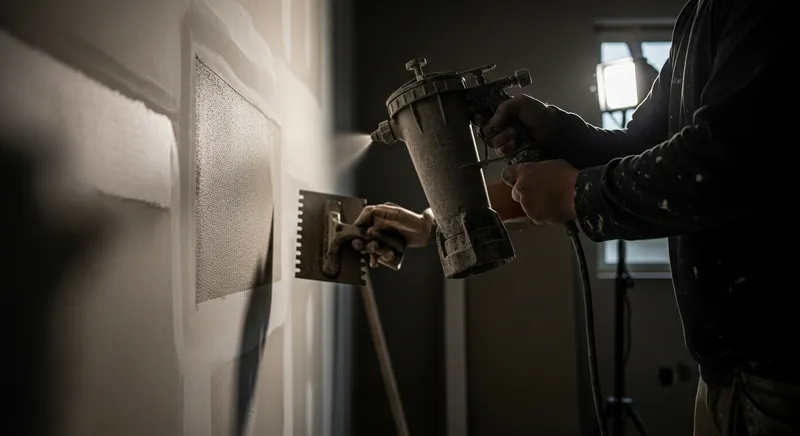
- Orange peel is matched with a spray hopper, tuning air pressure and mud thickness until test spray on cardboard matches the wall's droplet size — fine, medium, or heavy.
- Knockdown is sprayed the same way, allowed to set for a few minutes, then flattened with a wide knife at the same pressure the original finisher used, so the mottled islands are the same size and density.
- Skip trowel and hand textures are replicated freehand with a curved trowel, layering mud in the same rhythm and scale as the surrounding wall — the most skill-dependent match there is.
- Smooth walls are the hardest of all, because there's no pattern to hide in. The patch area gets skim-coated wide and sanded under raking light until it's optically flat — the same standard as a Level 5 finish.
Matching also means matching age. A 20-year-old orange peel wall has been painted several times, which rounds and softens the texture. A sharp fresh spray won't blend, so finishers adjust — often knocking the fresh texture down slightly or thinning the mud — to mimic paint-softened texture. Details like that are why texture matching is one of our specialties in the repairs and patching service; the four main Utah textures are compared in our texture types guide.
Why Does Paint Sheen Give Repairs Away?
Because sheen is direction-sensitive. Even perfectly color-matched paint reflects differently when it's new, when it's rolled with a different nap, or when it sits over fresh primer versus aged paint. At night, with lamps raking the wall, a touch-up painted only over the patch appears as a dull or glossy rectangle. The professional solution is to repaint to a natural break — corner to corner on the affected wall — so there's no boundary for your eye to find. On ceilings, that means repainting the whole ceiling plane after a ceiling repair.
What Affects the Cost of a Texture-Matched Repair?
The price depends on patch size and texture complexity — hand textures cost more to match than sprayed ones, and smooth walls take the most finishing time. Water-damage cutouts add the work of removing and replacing board, and repainting a full wall or ceiling plane for an invisible result adds paint time. Call (801) 791-9053 or use the contact form for a free written estimate. More on what drives repair pricing is in our drywall repair cost guide, and if you're weighing whether a heavily patched wall is worth more patches, see repair vs. replacement.
Can Every Texture Be Matched?
Virtually yes, in experienced hands. The rare exceptions are acoustic "popcorn" ceilings — which are usually better removed and refinished than patched, since patched popcorn almost never blends — and one-of-a-kind artisan finishes, where matching a section is possible but refinishing the full wall gives a cleaner result. If a contractor tells you your texture "can't be matched," that usually means *they* can't match it.
Invisible Repairs Across Northern Utah
Texture matching is the core of our repair work in Salt Lake City, Draper, Layton, and across Salt Lake, Davis, and Weber counties — homeowners tell us they can't find the spot afterward, which is the whole point. **Get a free estimate** or call (801) 791-9053.
Frequently Asked Questions
Why is my drywall patch still visible after painting?
One of five reasons: the patch isn't flat, the texture doesn't match, the paint sheen differs from the aged paint around it, the compound wasn't feathered wide enough, or the repair wasn't primed. A patch must get all five right to disappear.
How do professionals match orange peel texture?
With a spray hopper, tuning air pressure and mud consistency until test spray matches the wall's droplet size, then feathering the new texture into the old. Pros also soften fresh texture to mimic walls rounded by years of paint.
How much does a texture-matched drywall repair cost in Utah?
It depends on the size of the patch and the texture complexity. Hand textures like skip trowel cost more to match than sprayed textures, smooth walls take the most finishing time, and water-damage cutouts add board replacement. Call (801) 791-9053 or use the contact form for a free written estimate.
Do I have to repaint the whole wall after a drywall repair?
For a truly invisible result, usually yes — corner to corner. Even color-matched paint reflects differently over a fresh patch, so repainting to a natural break line removes the sheen boundary your eye would otherwise catch.
Can knockdown texture be patched invisibly?
Yes. The patch is sprayed like orange peel, allowed to set briefly, then flattened with a wide knife at the same pressure as the original application so the mottled pattern matches in size and density.
Can popcorn ceiling texture be patched?
It rarely blends well. Patched popcorn almost always shows, so the better long-term fix is usually removing the popcorn and refinishing the ceiling smooth or knockdown — often for less than homeowners expect.