Drywall vs. Plaster: What Utah Homeowners Need to Know Before Repairing or Renovating
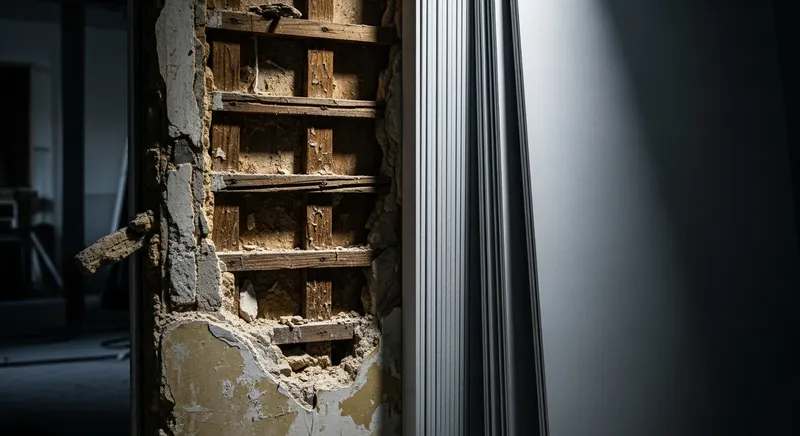
Quick Answer: Plaster is the harder, denser, more sound-dampening wall system found in most Utah homes built before about 1950; drywall is the faster, cheaper, easier-to-repair standard used ever since. Keep plaster that's in good condition — it's a premium material. Convert to drywall when plaster is extensively cracked, delaminating from its lath, or when walls are already open for a major remodel. Replacing plaster costs noticeably more than hanging drywall on open framing, because the dense plaster and lath have to be demolished and hauled out first.
What's the Difference Between Plaster and Drywall?
Plaster walls are built up wet, in multiple coats, over wood or metal lath nailed to the studs — a skilled-trade process that produces a rock-hard, monolithic surface. Drywall (also called sheetrock or gypsum board) is a factory-made panel screwed to the framing, with only the joints finished by hand. Plaster went out of mainstream use after World War II because drywall installs in days instead of weeks. If your home is in the Avenues, Sugar House, Marmalade, or central Ogden and was built before roughly 1950, you very likely have plaster; nearly everything built after 1960 in Utah is drywall.
How Can You Tell Which One You Have?
Push a thumbtack into an inconspicuous spot. It presses into drywall easily but won't penetrate plaster. Other tells: plaster walls sound dull and solid when knocked, often have gentle waves rather than dead-flat planes, and show horizontal hairline cracking patterns that follow the lath behind them. Drywall sounds hollower between studs and cracks along straight panel seams instead.
Is Plaster Better Than Drywall?
In several ways, yes — which surprises homeowners who assume old means inferior. Plaster is significantly denser, so it blocks sound better than standard drywall (a real amenity — getting similar performance from drywall requires the upgrades in our soundproofing guide). It's harder to dent, more fire-resistant per inch, and its slight surface irregularity is part of an older home's character. Drywall's advantages are practical: it's far cheaper to install and repair, every contractor knows how to work with it, and it doesn't crack from age the way plaster keys eventually do. Neither is "better" universally — the right call depends on condition.
When Should You Repair Plaster Instead of Replacing It?
Repair plaster when the damage is local and the wall is otherwise sound: isolated cracks, small holes, or a few spots where the plaster has come loose from the lath (these can often be re-secured with plaster washers or adhesive injection before skim-coating). A skilled finisher can skim-coat a wavy-but-solid plaster wall back to smooth for far less than gutting it. This is the preservation route we recommend for most owners of older homes in Salt Lake City — the material is worth keeping when it's keepable.
When Does Converting to Drywall Make Sense?
- Extensive delamination. Large areas where plaster has separated from the lath and moves when pressed — patching can't fix a failed bond at scale.
- Walls already open. If a remodel is gutting walls for wiring, plumbing, or insulation anyway, replacing with drywall is the obvious move — the demolition is already paid for. This is standard in the full remodels we run, including remodels in Salt Lake City and remodels in Ogden.
- Major electrical/insulation upgrades. Older plaster homes often need knob-and-tube replacement and wall insulation; open walls make both dramatically cheaper.
- Ceiling failure. Sagging plaster ceilings are heavy and hazardous — replacement with drywall is usually safer than re-securing.
What Drives the Cost of Each Option?
From least to most involved, the options usually run:
- Plaster crack or small hole repair — priced by the number and size of the areas
- Skim-coating a plaster wall smooth — priced by square footage and how wavy or cracked the wall is
- New drywall on open walls — when a remodel has already removed the old surface
- Demo plaster and hang new drywall — the most involved, because demolition and disposal come first
Plaster demolition is the expensive, messy part — it's dense, heavy, and comes off in chunks with the lath behind it. That's why conversion pencils out best when walls are opening anyway. Call (801) 791-9053 or use the contact form for a free written estimate. For more on what affects drywall-side cost, see our installation cost guide; for keeping old walls, the skim-coating process is closely related to the Level 5 finish work we do on new board.
Can New Drywall Match Old Plaster's Look?
Yes — this matters in partial renovations where a new drywall addition meets original plaster rooms. The trick is finishing the drywall to a higher level (usually a skim-coated Level 5) and matching any subtle texture so the transition is invisible, then trimming consistently. Blending new into old is exactly the kind of finish work covered in our texture matching guide, and it's a routine part of remodel work in Utah's older neighborhoods.
Older-Home Experts Across Northern Utah
Drywall Techs works on both sides of this decision — repairing and skim-coating plaster worth saving, and demoing/re-drywalling when conversion is the smarter spend. We'll give you a straight answer and a written line-item estimate either way. **Request a free estimate** or call (801) 791-9053.
Frequently Asked Questions
How do I know if my walls are plaster or drywall?
Push a thumbtack into an inconspicuous spot: it penetrates drywall easily but not plaster. Plaster also sounds dense when knocked, has slightly wavy surfaces, and is standard in Utah homes built before about 1950.
Is plaster better than drywall?
Plaster is denser, blocks sound better, resists dents, and adds character to older homes. Drywall is much cheaper to install and repair. Well-bonded plaster is worth keeping; failed plaster is worth replacing with drywall.
How much does it cost to replace plaster with drywall in Utah?
It costs more than hanging drywall alone, because the plaster and lath have to be demolished and hauled out first. The total depends on square footage, ceiling height, and how much electrical or insulation work happens while the walls are open. Conversion is most economical when walls are already being opened for a remodel. Call (801) 791-9053 or use the contact form for a free written estimate.
Can cracked plaster walls be repaired without replacement?
Usually yes. Isolated cracks and small holes are patched, loose sections can be re-secured with plaster washers or adhesive, and wavy-but-solid walls can be skim-coated back to smooth for far less than gutting them.
Should I remove plaster during a remodel?
If the remodel is already opening walls for wiring, plumbing, or insulation, yes — the demolition cost is already committed, and new drywall gives you flat, easily repairable walls. If walls aren't opening, keep sound plaster.
Can new drywall blend seamlessly with original plaster?
Yes. Finishing the new drywall to a skim-coated Level 5 standard and matching any surface texture makes the transition between new and original walls invisible after paint.